
Introduction
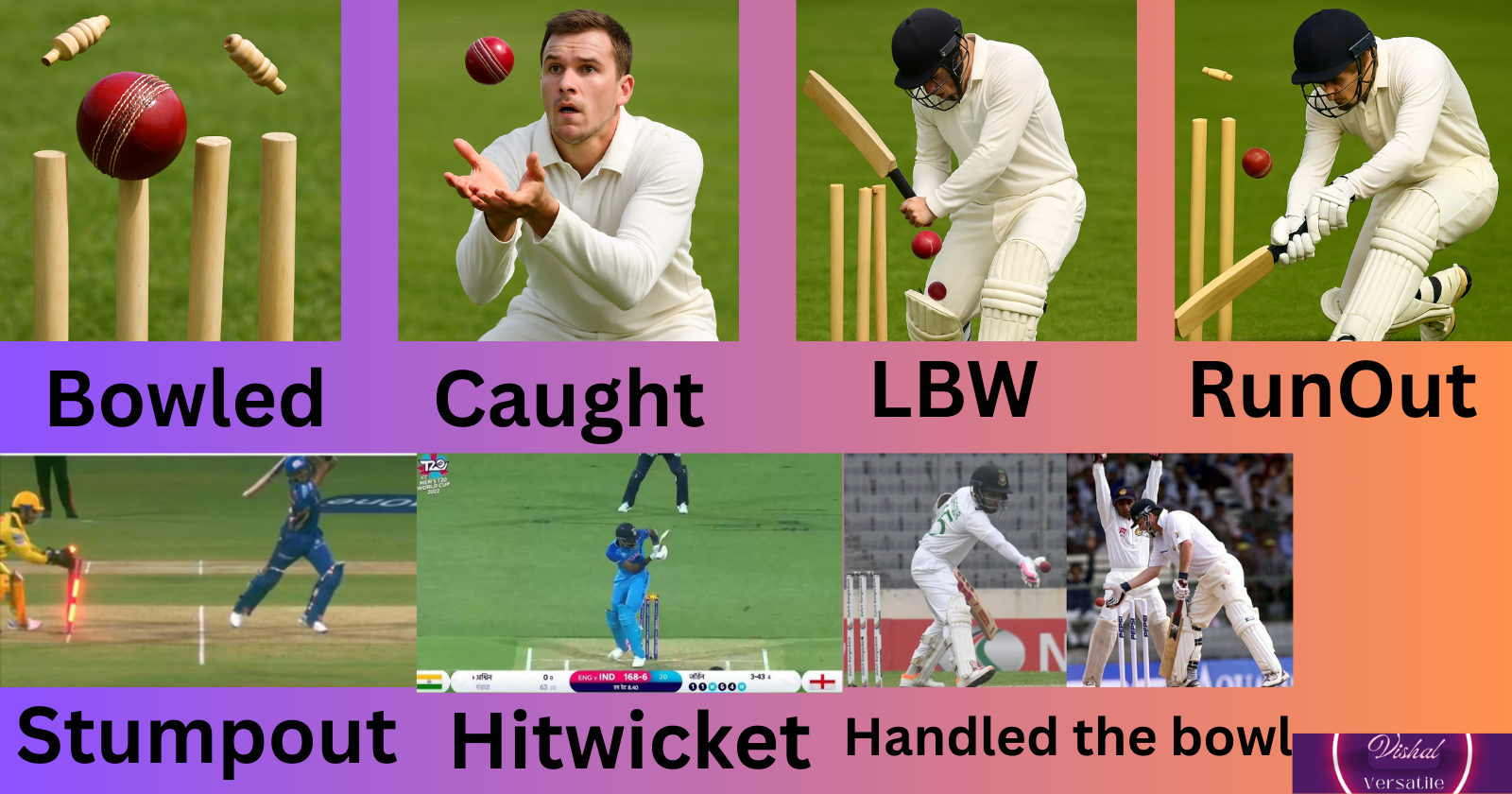
‘How many ways can a batter be out in cricket?’, is a question asked by cricket fans all around the world. They want to know more about the weird dismissals.
- A batter can be dismissed in cricket in 10 official ways according to the laws of cricket.
- Cricket is a sport of great uncertainties. When a wicket falls or a double breakthrough occurs, it changes the course of the game.
- Bowlers work extremely hard to get wickets in any format of the game.
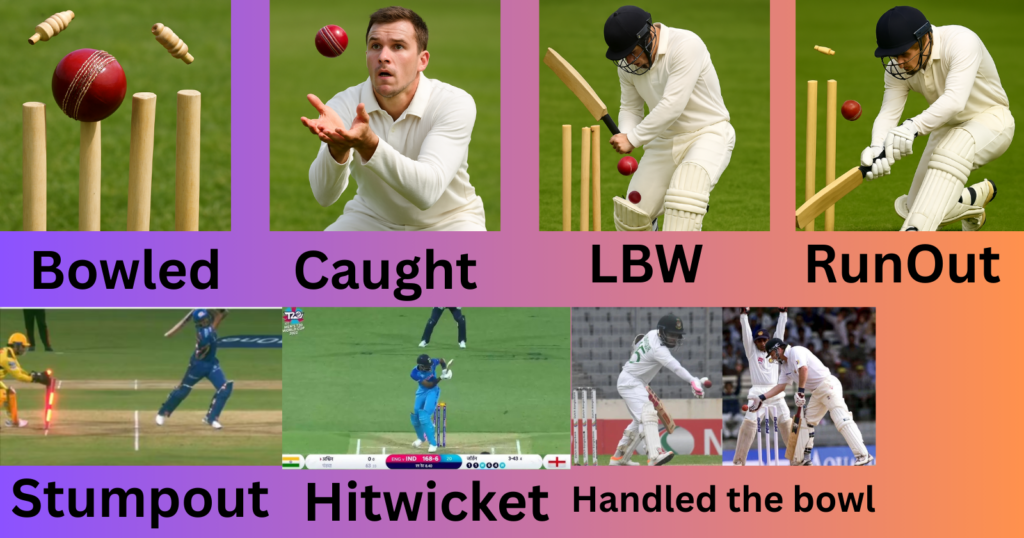
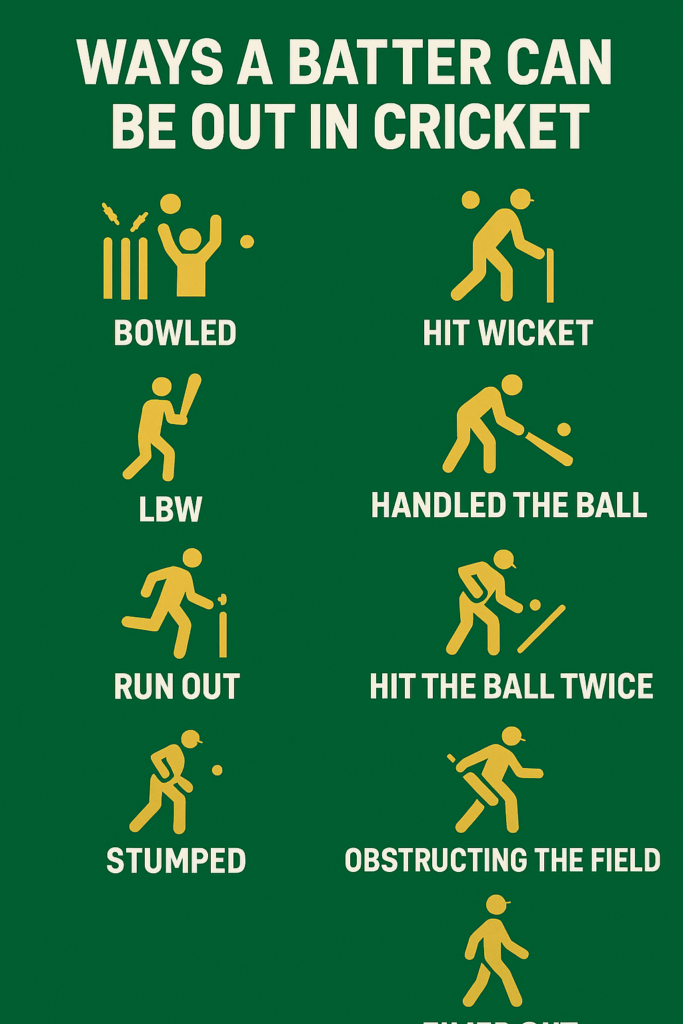
- The dismissals could be:-
| Dismissal Type | Explanation | Frequency |
| Bowled | Ball hits the stumps and dislodges the bails. | Very common |
| Caught | Ball is caught by a fielder, wicketkeeper, or bowler before touching the ground. | Very common |
| Leg Before Wicket (LBW) | Batter is out if the ball strikes their body (usually pads) in line with the stumps and would have hit them. | Common |
| Run Out | Batter is out if the fielding side breaks the stumps while they are out of their crease attempting a run. | Common |
| Stumped | Wicketkeeper removes the bails while batter is out of crease (not attempting a run). | Fairly common in spin bowling |
| Hit Wicket | Batter accidentally hits the stumps with bat, body, or clothing while playing a shot or setting off for a run. | Rare |
| Handled the Ball | Batter deliberately touches the ball with their hand not holding the bat (now covered under “obstructing the field”). | Extremely rare |
| Obstructing the Field | Batter deliberately obstructs fielders with words or actions. | Very rare |
| Timed Out | Batter fails to arrive at the crease within 3 minutes of the previous dismissal. | Extremely rare |
| Hit the Ball Twice | Batter strikes the ball twice (except for protecting the wicket). | Extremely rare |
- The bowler could be a pace bowler, medium pace bowler, off spinner or a leg spinner, it could be a left hand bowler or a right hand bowler.
- The right hand pacers most iconic weapon is the out-swinger. It is used to get the batter caught behind the wicket by the keeper.
- A great yorker is enough to get an LBW(Leg Before Wicket) or a bowled. Even a great in-swinger could get both. So it is important to learn all kind of skills as a pace bowler.
- As a batter if you miss any kind of a delivery and the ball hits the stumps, it is called a bowled as the ball comes back in and then hits the stump.
- For an LBW, it is necessary that, the ball pitches inline with the stumps and the impact of the ball should be inline with the stumps.
- Previously the umpire used to decide the LBW. now the players have the DRS(Decision Review System) i.e. the player can decide to review the umpire’s decision, of out or not out to the third umpire. The third umpire views it on the TVs to give it final decision.
- As the technology is used, the number of human errors have greatly reduced, which makes the the gentleman’s game fairer.
- As a fielding side you should be smart enough to get Runouts. A great fielders capability is to hit the stumps directly on throws. Stopping the ball by diving on it doesn’t let the credit away from the fielder.
- Runouts in test cricket are considered as an act of stupidity but that doesn’t take the credit away from the fielder.
- If a bowler takes a runup, and reaches the crease to bowl, in this process he sees that the non striker is leaving the crease before the he bowls, the bowler can directly hit the stumps with the bowl in his hand at the Non- Strikers end, to get a runout as the Non-Striker is not in the crease during that time. It is a rare occasion while such runouts occur.
- Most common dismissals: Bowled, caught, LBW, run out.
- Rare dismissals: Timed out, hit the ball twice, obstructing the field. These are so unusual that many professional players never encounter them in their careers.
- Law updates: “Handled the ball” was merged into “obstructing the field” in 2017, but it’s still often listed separately in discussions.
- ‘Timed Out’ has happened only a handful of times (never in Tests, once in ODIs, once in T20Is, and about 7 times in first-class cricket). ‘Hit the Ball Twice’ is even rarer, with just one known international instance and a few domestic cases.**
- Timed Out Dismissals:
- Definition: A batter must be ready within 3 minutes of the previous dismissal. If not, the fielding side can appeal.
- Instances:
- Test cricket: None recorded to date.
- ODI cricket: One instance.
- T20I cricket: One instance (most famously Angelo Mathews vs Bangladesh in 2023, when he was timed out for equipment delay).
- First-class cricket: Around 7 recorded cases.
- Example:
- Angelo Mathews (Sri Lanka) – Timed out in a T20I against Bangladesh (Nov 2023). His helmet strap broke, delaying his arrival at the crease, and Bangladesh appealed successfully.
- Hit the Ball Twice Dismissals
- Definition: Batter is out if they deliberately strike the ball a second time (except to protect their stumps).
- Instances:
- International cricket: Only one known case – Fanyan Mughal (Malta) vs Romania in the 2023 Continental Cup.
- Domestic cricket: Rare but recorded, e.g., Lamabam Singh (Manipur) dismissed in a Ranji Trophy match against Meghalaya in 2025.
- Examples:
- Fanyan Mughal (Malta) – Out for hitting the ball twice in the Continental Cup 2023.
- Lamabam Singh (India) – Out in Ranji Trophy Plate League (Nov 2025) for hitting the ball twice.
| Dismissal | Frequency | Famous Example |
| Timed Out | 0 in Tests, 1 in ODIs, 1 in T20Is, ~7 in first-class | Angelo Mathews vs Bangladesh (2023) |
| Hit the Ball Twice | 1 in international cricket, rare in domestic | Fanyan Mughal (Malta, 2023), Lamabam Singh (Ranji Trophy, 2025) |
Official Account of ICC(International Cricket Counsil) on Twitter
Latest information about DRS(Decision Review System) in cricket
Latest Update (Jan 2026): The Decision Review System (DRS) continues to evolve in cricket. The ICC has recently updated protocols for reviews, while the BCCI is actively considering introducing DRS in Indian domestic cricket to improve fairness and align with international standards.
Timeline based on Ways of cricketing wickets
How many children are there of Virat Kohli?
Frequently Asked Questions(FAQs)
How many official ways can a batter be dismissed in cricket?
According to the Laws of Cricket, there are 10–13 recognized modes of dismissal, depending on how you categorize rare cases like “timed out” or “retired out.” Common ones include bowled, caught, LBW, run out, and stumped.
Which dismissal is the rarest in professional cricket?
The “timed out” dismissal is extremely rare. It occurs when a new batter fails to arrive at the crease within the stipulated time (usually 2–3 minutes). Angelo Mathews became the first player in international cricket to be dismissed this way in 2024.
Can a batter be dismissed without the ball hitting the bat or stumps?
Yes. Dismissals like LBW (leg before wicket), run out, stumped, hit wicket, obstructing the field, and timed out don’t require the ball to hit the bat directly.
What’s the difference between ‘retired hurt’ and ‘retired out’?
Retired hurt: The batter leaves due to injury/illness and may return later.
Retired out: The batter voluntarily leaves without injury and cannot return, which counts as a dismissal under the Laws of Cricket.
Are all dismissals equally common in matches?
No. Caught and bowled are the most frequent dismissals, making up the majority in professional cricket. Rare dismissals like handled the ball (now part of obstructing the field), hit the ball twice, or timed out are seldom seen.